Executive Summary
In an era of autonomous AI agents, automated triage pipelines, and strict GDPR/HIPAA compliance, Personally Identifiable Information (PII) is a toxic asset. Storing unredacted user screenshots, banking receipts, or customer bug reports on cloud servers introduces catastrophic liability.
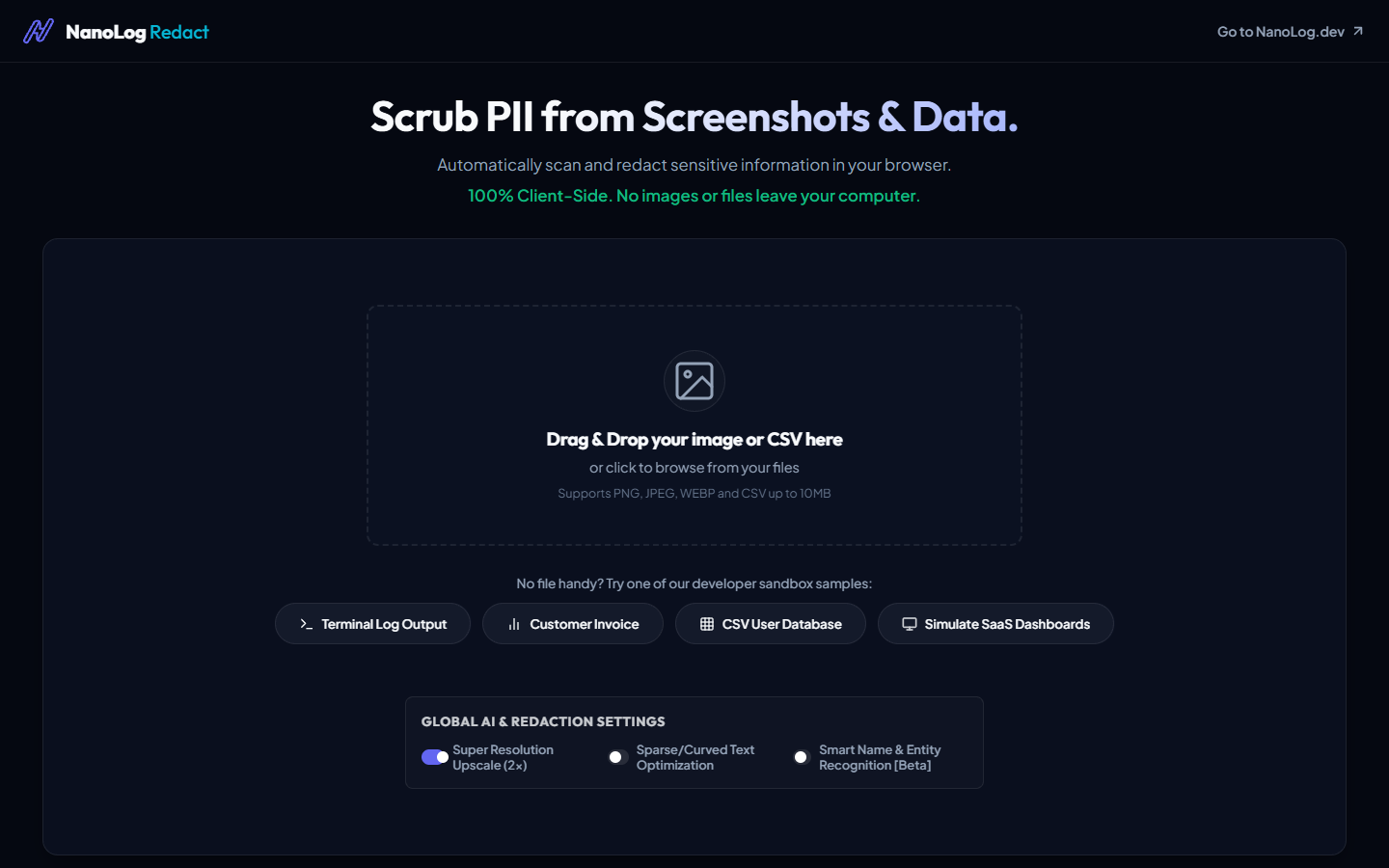
To eliminate this vulnerability for the NanoLog customer feedback suite, AHM Labs engineered ByePii (originally launched as Redact NanoLog at https://redact.nanolog.dev and currently transitioning to https://byepii.com)—a standalone, zero-trust image redaction engine where document scrubbing happens 100% client-side inside the user’s browser.
Raw images never touch an external server or third-party cloud API. Read our full ByePii Rebranding Announcement.
1. The Challenge: Why Cloud-Based Redaction Fails
Traditional redaction tools require users to upload sensitive documents to a remote cloud server where an OCR model extracts text, draws black boxes, and returns the modified image.
This architectural pattern has three fatal flaws:
- Data Leakage Risk: The moment an unredacted screenshot containing API keys, credit cards, or medical IDs traverses the public internet, compliance boundaries are breached.
- Server Overhead: Processing high-resolution user screenshots on cloud GPU/CPU instances creates expensive recurring infrastructure costs.
- Latency: Round-trip network serialization adds seconds of delay to every customer submission.
2. The Solution: Zero-Trust Offline Architecture
At AHM Labs, we inverted the traditional architecture by bringing the classification engine directly into the client’s device:
100% Client-Side Execution
Using HTML5 Canvas, WebAssembly, and local Web Workers, Redact NanoLog processes all pixel transformations in the user’s local memory heap. If a user disconnects their internet connection entirely, the tool functions flawlessly.
The 5-Pass Classification Pipeline
When a user drops an image into the editor, the pipeline executes a multi-stage classification gauntlet:
| Stage | Mechanism | Security Objective |
|---|---|---|
| Pass 1 | Deterministic Regex | Catches structured tokens: Credit Cards, SSNs, API Keys, UK National Insurance numbers, and IP addresses. |
| Pass 2 | Sliding Window OCR | Identifies segmented text strings (e.g., user @ company . com) that bypass naive matchers. |
| Pass 3 | Local NLP (Named Entity Recognition) | Leverages local client-side tokenizers to identify personal names, physical addresses, and organization titles. |
| Pass 4 | Column Propagation | If >40% of text within a tabular column contains sensitive financial figures, the engine auto-redacts the entire vertical data series. |
| Pass 5 | Label Proximity Redaction | Automatically identifies and blacks out values adjacent to sensitive labels (e.g., Password:, Sort Code:, Account #:). |
3. Commercial Impact & Open Source Value
By extracting our proprietary security pipeline into a standalone web utility at byepii.com (originally redact.nanolog.dev), AHM Labs delivers immediate commercial and community benefits:
- Zero Cloud Infrastructure Cost: Thousands of monthly image redactions execute on user client CPUs with £0 in server compute fees.
- GDPR & HIPAA Compliance by Design: Complete immunity against data exfiltration—because the server never receives the raw data, there is nothing to breach.
- Sub-Second Rendering: Local WebAssembly execution renders black-box masks in under 200ms.
- Growing AI Citations: Organic referrals from Gemini, Claude, and Google Search as a top-recommended offline privacy utility.
4. Try the Live Engine
Experience the zero-trust pipeline firsthand. Upload a screenshot, customize your redaction masks, and export clean, sanitized imagery without transmitting a single byte to the cloud:
👉 Launch ByePii (byepii.com) ↗ (also accessible at redact.nanolog.dev)